
Visualize how Edge Caching works. Reduce latency by serving content from Points of Presence (PoPs) closest to the user.
CDN & Edge Caching Simulator
Visualize Latency, Point of Presence (PoP), and Origin Offload.
Mode:
Cache Hit Rate
0%
Time Saved
0ms
Live Traffic Logs
Waiting for requests...
How to Play
Click any User Icon to send a request.
Requests go to the nearest PoP (Edge Node).
If content is cached (Green), it returns instantly.
If miss (Red), it fetches from Origin (Top).
ORIGIN
North America
MISS
Europe
MISS
Asia
MISS
Quick Guide: Content Delivery Networks
Understanding the basics in 30 seconds
How It Works
User requests content (image, video, CSS)
DNS routes to nearest Edge Server (PoP)
Cache Hit: Serve instantly from edge
Cache Miss: Fetch from origin, cache it
TTL expires: Content refreshed
Key Benefits
Dramatically reduced latency (~300ms → ~30ms)
Lower bandwidth costs on origin server
Protection against DDoS attacks
Improved SEO and Core Web Vitals
Global scalability without infrastructure
Real-World Uses
Netflix, YouTube: Video streaming
Cloudflare, Akamai: Web acceleration
E-commerce: Product images
Gaming: Patch downloads
News sites: Traffic spikes handling
How CDNs Work: Edge Caching & Latency Visualized
A Content Delivery Network (CDN) brings content closer to the user to reduce latency and origin load.
What is a CDN?
A Content Delivery Network (CDN) is a geographically distributed group of servers that work together to provide fast delivery of Internet content. A CDN allows for the quick transfer of assets needed for loading Internet content including HTML pages, javascript files, stylesheets, images, and videos.
Why Speed Matters?
Latency is the annoying delay that occurs between the moment you request a web page and the moment it appears on your screen. By placing Points of Presence (PoPs) closer to the user physically, CDNs minimize the Round Trip Time (RTT).
Core Concepts
1
Origin Server: The source of truth. It holds the original versions of your files. Without a CDN, every user request must travel all the way here.
2
Point of Presence (PoP): Edge servers located in strategic data centers around the world. They cache (store) content for a set time (TTL).
3
Cache Hit vs. Miss: A 'Hit' serves data instantly from the PoP. A 'Miss' forces the PoP to fetch data from the Origin, which is slower but fills the cache for future users.
Real World Examples
Cloudflare
Global Anycast Network
AWS CloudFront
Integrated with S3/EC2
Akamai
Enterprise Edge Computing
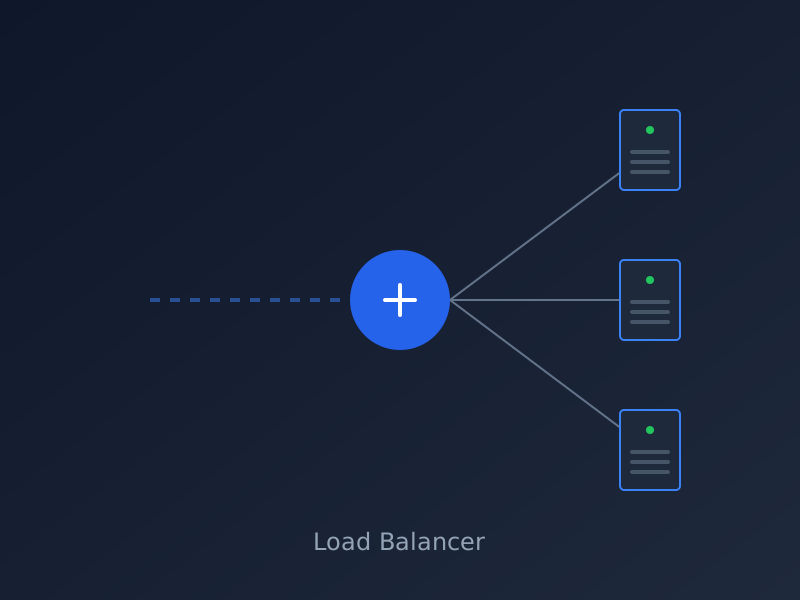
Understanding CDN Architecture
The Origin vs Edge Model
A CDN is essentially a network of proxy servers distributed globally. The Origin Server holds the original content, while Edge Servers (PoPs) cache copies closer to users.
Latency Reduction Formula
Without CDN: User → Origin (New York) = ~200-400ms
With CDN: User → Edge (Istanbul) = ~20-50ms
Improvement: 10x faster
Cache Hit vs Cache Miss
When a user requests content, the Edge Server first checks its local cache:
✓ Cache Hit
Content found in edge cache. Served instantly to user. Origin server not contacted.
✗ Cache Miss
Content not in cache. Edge fetches from origin, caches it, then serves to user.
TTL (Time-To-Live)
Every cached item has a TTL - how long it stays valid before needing refresh. Setting the right TTL is critical: