AI & Prompting Series

Prompt Anatomy Simulator

See how system role, context, examples, and constraintschange the shape and reliability of an LLM response.

Prompt Anatomy Simulator

Toggle the building blocks of a production prompt and watch how reliability, structure, and risk change. The goal is not to make the prompt longer - it is to make the prompt more intentional.

Task Preset
Prompt Blocks
Specificity: 72
Temperature: 32
Prompt Blocks

Each enabled block reduces ambiguity in a different way.

User TaskSpecific

Explain why this API is returning HTTP 429 responses under burst traffic, and propose the smallest safe mitigation plan.

System RoleOn

You are a senior backend engineer. Explain problems precisely, prefer root cause analysis, and keep fixes incremental instead of speculative.

ContextOn

The service sits behind a gateway with per-key throttling. Average traffic is normal, but short bursts from one integration trigger 429s and retries amplify the spike.

ConstraintsOn

Do not blame the database unless evidence exists. Avoid rewriting the architecture. Prefer safe operational fixes first.

Output FormatOn

Respond with sections: Root Cause, Immediate Fix, Safer Long-Term Fix.

Assembled Prompt

Prompt text gets clearer as you layer intent, context, and boundaries.

125 tokens
100 words
SYSTEM ROLE
You are a senior backend engineer. Explain problems precisely, prefer root cause analysis, and keep fixes incremental instead of speculative.

USER TASK
Explain why this API is returning HTTP 429 responses under burst traffic, and propose the smallest safe mitigation plan.

CONTEXT
The service sits behind a gateway with per-key throttling. Average traffic is normal, but short bursts from one integration trigger 429s and retries amplify the spike.

CONSTRAINTS
Do not blame the database unless evidence exists. Avoid rewriting the architecture. Prefer safe operational fixes first.

OUTPUT FORMAT
Respond with sections: Root Cause, Immediate Fix, Safer Long-Term Fix.
Likely Model Behavior

This is a heuristic preview of how output quality shifts.

Useful but somewhat uneven

Strong prompts do not just sound smart. They reduce ambiguity before the model starts guessing.

What improves
  • +Role framing makes the assistant pick a clearer voice and decision style.
  • +Context reduces guessing and keeps the answer anchored to the real situation.
  • +Constraints remove unsafe or overly broad behavior before the model starts writing.
  • +Output format makes the answer easier to scan and easier to compare.
What still breaks
  • !No example means tone and structure may drift from run to run.
Sample output shape
The API is probably rate limited during bursts. Check the gateway policy first and reduce aggressive retries.
Clarity100
Grounding58
Structure69
Creativity30

Quick Guide: Prompt Anatomy

Understanding the basics in 30 seconds

How It Works

  • Pick a task preset such as support, coding, or launch messaging
  • Toggle role, context, examples, constraints, and output format blocks
  • Change specificity and temperature to widen or narrow the answer space
  • Watch the assembled prompt and heuristic quality metrics update live
  • Compare how the likely model behavior changes when blocks are missing

Key Benefits

  • Makes prompt quality visible instead of abstract
  • Explains why generic prompts lead to generic output
  • Shows how constraints and examples reduce drift
  • Helps teams debug prompt failures before shipping
  • Creates a shared vocabulary for prompt reviews

Real-World Uses

  • Support bots that must stay calm and policy-safe
  • Coding copilots that need precise, bounded diagnostics
  • Marketing assistants that must follow tone and positioning
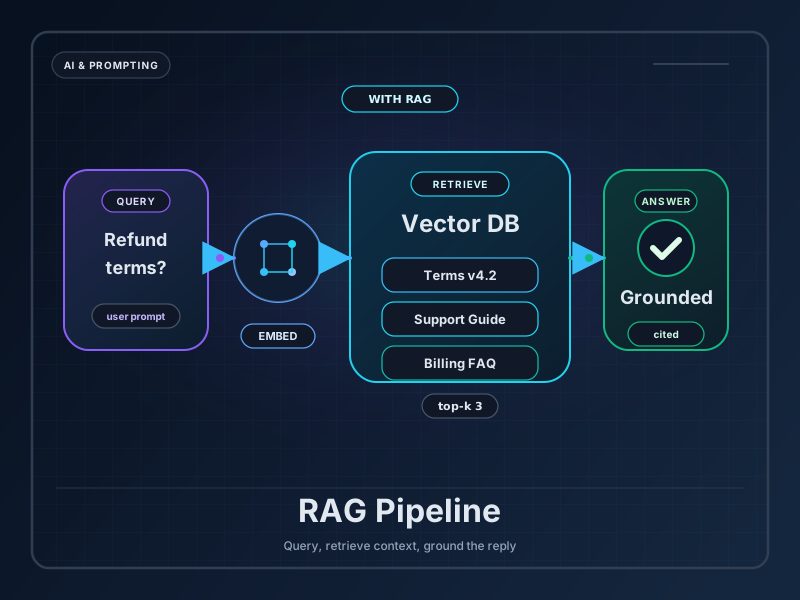
  • RAG systems that need grounded output instead of guessing
  • Multi-agent workflows with strict output contracts

Prompt Anatomy Explained

1. What prompt anatomy really means

A production prompt is not just one sentence. It is usually a layered instruction stack: who the model should act like, what the task is, what context matters, what examples define quality, what constraints must never be crossed, and what shape the output should take.

When teams say a model feels inconsistent, the problem is often not the model first. The problem is missing structure in the prompt. Prompt anatomy makes those missing pieces visible.

2. The six blocks that change output quality

System Role

Shapes voice, decision style, and what kind of assistant the model should become.

Context

Anchors the answer to the actual scenario instead of leaving the model to guess.

Examples

Show what good looks like so structure and tone do not drift as easily.

Constraints

Prevent unsafe behavior, over-promising, or domain mistakes before they happen.

Output format and task specificity are the final two multipliers. They make the answer easier to compare, easier to score, and easier to trust in repeated runs.

3. Trade-offs

Advantages

  • More consistent answers across runs
  • Lower hallucination risk in operational tasks
  • Cleaner output for downstream automation
  • Faster debugging when quality drops

Trade-offs

  • Longer prompts consume more context window
  • Too many constraints can reduce exploration
  • Bad examples can lock the model into the wrong pattern
  • Verbose prompts still fail if the task itself is unclear
A Practical Prompt Review Checklist

What strong prompts usually have

  • A clear role that matches the decision style you want
  • Enough context to avoid guessing hidden business details
  • At least one example when tone or structure matters
  • Constraints that block unsafe or noisy behavior
  • An output format that makes the answer easy to consume downstream

What weak prompts usually do

Common failure mode

The prompt asks for a high-quality answer but never defines the role, constraints, or the format of a good result.

Better alternative

Name the role, include only the context that matters, and specify what the final answer should look like before the model starts writing.